
Climate Transition Plans: Real Strategy or ESG Window Dressing?
- harshas2883
- Jun 29
- 2 min read
Is it possible for a company to assert a net-zero status without outlining its strategy to achieve it? Can a sustainability report be deemed reliable if it includes targets but lacks a transition roadmap?
As ESG evolves, companies are progressing from general climate commitments to a more serious undertaking: climate transition plans.
A climate transition plan serves as a company's strategy for reducing emissions, altering operations, financing decarbonization, and remaining competitive in a low-carbon economy. Essentially, it addresses one key question:
What is your concrete plan to achieve net zero?
Climate Transition Plans: Data Insights
The statistics reveal both progress and a gap in credibility.
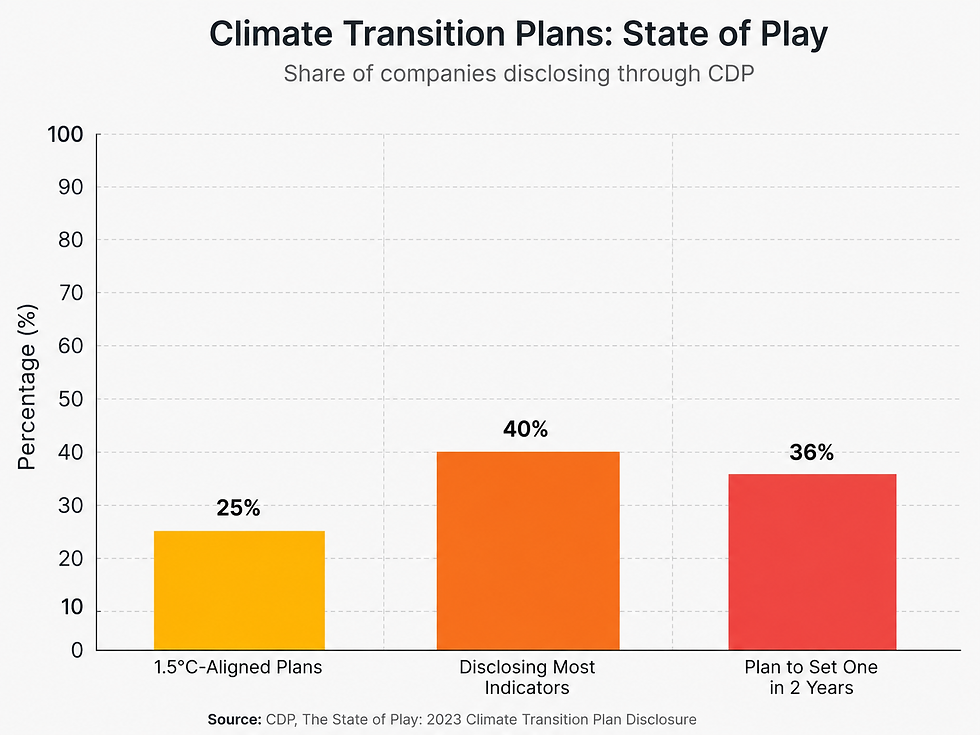
According to CDP, 25% of companies reported having a 1.5°C-aligned climate transition plan, marking a 44% increase from the previous year. However, only 140 companies provided sufficient information across all 21 indicators used by CDP to assess the credibility of a transition plan.
This indicates that while many companies are making climate commitments, very few are providing adequate details to demonstrate that their plans are measurable, financed, and operationally viable.
The finance gap is equally concerning. CDP notes that transition finance must increase from US$2 trillion to US$6.7 trillion annually by 2030 to support a credible real-economy transition.
From Net-Zero Commitment to Business Reality
Historically, companies could release sustainability reports featuring emissions data, CSR projects, and long-term targets. However, investors, regulators, and customers now demand stronger evidence.
A credible transition plan must demonstrate:
How emissions will decrease annually.
How Scope 1, 2, and 3 emissions will be addressed.
The investment required.
The responsible teams.
How climate risks impact the business model.
How progress will be tracked and reported.
Without this, net zero remains a promise without a pathway.
Potential Pitfalls
The greatest risk is transition-washing.
This occurs when companies release appealing climate roadmaps without implementing genuine operational changes. A plan may appear impressive, but if it lacks interim targets, a budget, board accountability, and supplier engagement, it is merely another ESG document.
For instance, a manufacturing company may declare net zero by 2050. However, if it lacks plans for renewable energy, low-carbon materials, supplier emissions, green skills, and capex alignment, the claim becomes insubstantial.
Importance for CSR Teams
Climate transition is not solely an ESG reporting concern. CSR teams can significantly contribute by supporting green skilling, climate-resilient livelihoods, MSME supplier capacity building, women-led climate entrepreneurship, water conservation, and community adaptation.
This is where CSR can evolve from philanthropy to climate resilience.
A Call to Action for Transition
If you are a business leader, do not stop at a net-zero announcement. Develop a transition plan that is measurable, financed, and accountable.
If you are an ESG or CSR professional, acquire knowledge in climate risk, carbon accounting, transition finance, Scope 3 emissions, and regulatory readiness.
If you are an investor or consumer, demand that companies present the roadmap, not just the promise.
The future of ESG will not be determined by those who make the boldest climate claims.
It will be defined by those who can substantiate the transition.


Comments