
Could ESG Reporting Become an API Instead of a Report?
What happens when sustainability data stops being something companies publish and becomes something machines can request, exchange and use?
For decades, the sustainability report has been the dominant container for corporate ESG information. Every year, companies gather environmental, social and governance data, organize it into hundreds of pages, publish a polished document and distribute it to investors, regulators, employees and other stakeholders. The report is useful for humans. But increasingly, the most important consumers of ESG information may not be human.
Investors use software to compare companies. Banks incorporate sustainability information into risk models. Procurement platforms evaluate suppliers. Regulators process disclosures. ESG analytics providers aggregate thousands of companies. Artificial intelligence systems increasingly depend on structured information rather than pages of unstructured prose.
This raises a provocative question: What if the future of ESG reporting is not another better-designed PDF? What if ESG data becomes infrastructure? Instead of waiting for an annual report, a system could request a company's relevant sustainability data through standardized digital interfaces. Instead of downloading a document and extracting numbers from it, another system could receive structured information directly. In that world, ESG reporting begins to look less like publishing and more like an API.
The Problem With ESG Data Living Inside Documents
A conventional sustainability report creates a strange paradox. A company may spend months collecting thousands of data points, calculating emissions, documenting energy consumption and compiling workforce information. Yet much of that information ultimately reaches the outside world as pages of prose, tables and charts. A human can read those pages. A machine has a much harder time. Even when the same metric appears in reports from two companies, differences in terminology, units, definitions, reporting periods and document structures can make automated comparison difficult.
This is one reason machine-readable reporting has become increasingly important.
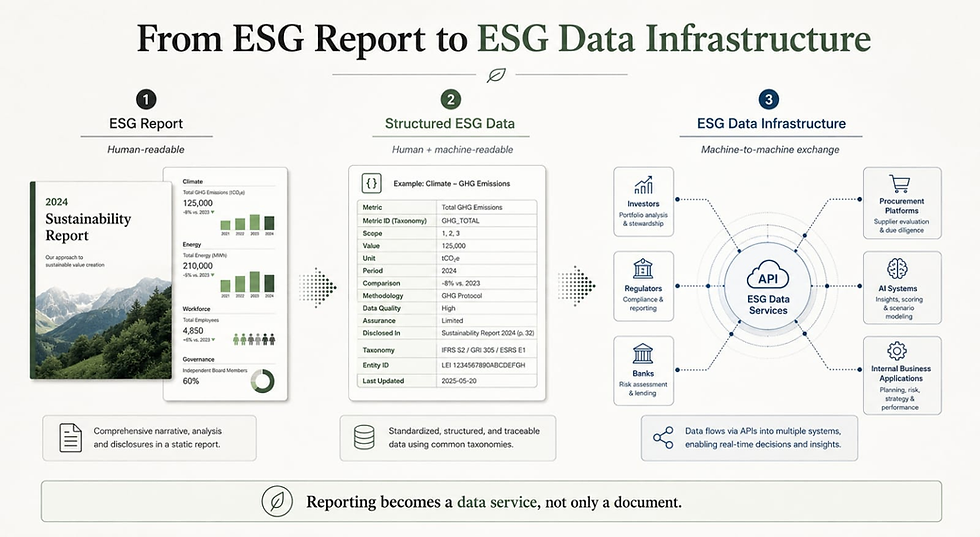
XBRL, the global standard for digital business reporting, allows information to be tagged so that it can be understood and analysed by software. Digital sustainability disclosures can therefore remain readable by humans while also becoming structured and machine-readable. The distinction is fundamental. A PDF tells a computer where information appears. Structured data tells a computer what the information means. That is the difference between a document and a data layer.
What Would an ESG API Actually Do?
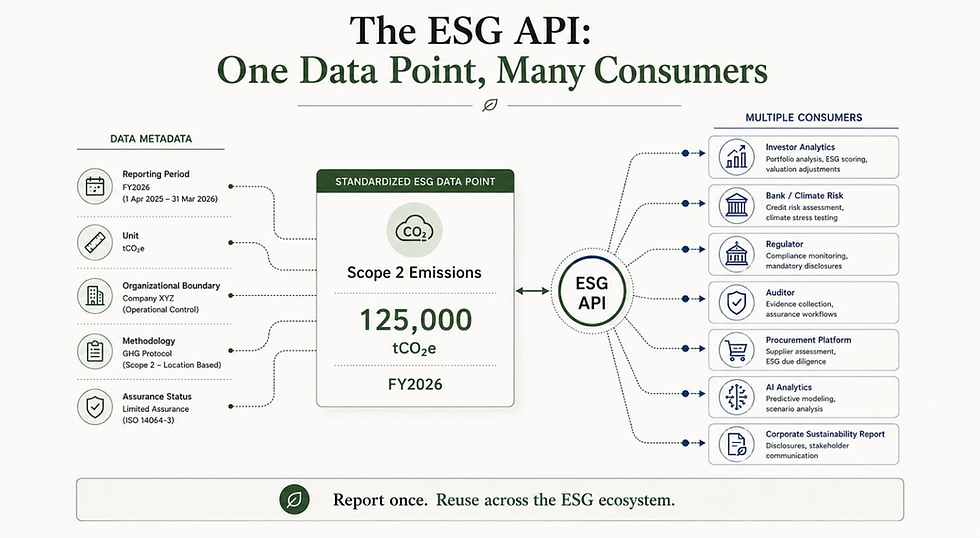
An API, or Application Programming Interface, allows different software systems to communicate with one another. In simple terms, one system can request information from another system in a predefined format. Imagine a bank evaluating the climate exposure of a corporate borrower. Under a document-centric model, the bank might download a sustainability report, locate the relevant emissions information, determine the reporting period, interpret the methodology and manually or semi-automatically transfer the information into its own systems. Under an API-oriented model, the bank's system could request standardized information directly from an ESG data service. For example,
Company → Scope 1 emissions → Reporting year → Value → Unit → Methodology → Assurance status
The response would not need to be a paragraph. It could be structured data. The bank could then automatically feed that information into its climate-risk model. The same principle could apply to other users. A procurement platform could request supplier emissions data. An investor platform could request standardized climate-risk indicators. A regulator could retrieve required disclosures.\ An internal sustainability team could connect operational systems directly to its reporting infrastructure. The underlying data could potentially be reused across multiple applications rather than repeatedly extracted from a published report. That is the real significance of the API idea. It changes ESG data from something that is primarily consumed after publication into something that can become continuously accessible to authorized systems.
ISSB Is Already Building the Digital Layer
The idea of machine-readable sustainability information is not hypothetical. The International Sustainability Standards Board has already developed the IFRS Sustainability Disclosure Taxonomy for information prepared under IFRS S1 and IFRS S2. The taxonomy allows companies to tag sustainability-related financial information so that investors and other users can search, extract, compare and analyse disclosures more efficiently.
In July 2026, the ISSB also published a proposed update to its Sustainability Disclosure Taxonomy following amendments to greenhouse-gas emissions disclosures. The proposed update continues the move toward structured digital sustainability reporting and is open for comment until 28 September 2026.
This matters because taxonomies provide something an API needs before the API itself can become useful: a common understanding of what the data actually means. An API can move information very efficiently. But if one company reports “renewable energy use” using one definition and another company uses a different definition, moving the data faster does not make the data comparable. The plumbing is not enough. The data model matters.
A Common Language Comes Before the API
Imagine two companies sending an API request for “employee turnover.” If Company A defines turnover as voluntary departures and Company B includes every employee leaving for any reason, both systems may technically return valid data. But the numbers cannot be meaningfully compared. This is why digital ESG infrastructure depends on standardization. Taxonomies, common definitions, units, reporting periods, industry classifications and metadata create the semantic layer that allows machines to interpret sustainability information consistently.
XBRL's digital sustainability work emphasizes exactly this issue: standardized structures allow sustainability information to be collected and reported in ways that make it more accessible, comparable and machine-readable. The implication is important. The future of ESG reporting may not begin with APIs. It begins with agreeing on what the data means. Once that foundation exists, APIs can become the transport layer.
What If ESG Data Became a Shared Business Utility?
Consider how financial data works inside modern organizations. A company's finance system does not wait until the annual report to discover its revenue. Financial information is generated, processed and exchanged continuously across internal systems. ESG data could move in a similar direction. Energy systems could feed electricity consumption data into sustainability platforms. Procurement systems could provide supplier information. HR systems could provide workforce indicators. Facilities systems could provide building-level energy data. Environmental monitoring systems could provide operational measurements. These data streams could feed a centralized ESG data layer. The reporting function would then become one output of that system rather than the place where the data is first assembled. The company could generate a regulatory disclosure from the same underlying data that powers its internal sustainability dashboard, investor communications, supplier assessments and climate-risk analysis. That would represent a major architectural change.
Instead of: Operational systems → Spreadsheet → Sustainability team → Annual report
the model could become: Operational systems → ESG data layer → APIs → Multiple users and applications

The Report Does Not Disappear
Calling this an “API instead of a report” can be misleading. The annual sustainability report still has an important role. Investors, employees, policymakers and the public need context. Numbers alone cannot explain strategy, materiality, risks, governance decisions or the reasoning behind corporate priorities. A machine can consume a Scope 1 emissions value. It cannot automatically understand the full strategic context surrounding that number. The likely future is therefore not: Report versus API. It is: Report + structured data + APIs. The report becomes the human-facing narrative layer. Structured data becomes the machine-readable evidence layer. APIs become the exchange mechanism. Assurance becomes the trust layer. Together, they form a much more powerful reporting ecosystem.
Why APIs Could Change ESG Comparability
One of the biggest problems in ESG analysis is comparability. Investors may want to compare emissions intensity across hundreds of companies. Banks may want to assess climate exposure across thousands of borrowers. Procurement teams may want to compare suppliers. Today, that can involve enormous amounts of data extraction and normalization.
Machine-readable reporting can reduce some of this friction.
The IFRS Sustainability Disclosure Taxonomy was specifically designed to help users consume sustainability-related information digitally and enable more efficient extraction, comparison and analysis. XBRL's digital reporting model similarly allows software to analyse information across many reports rather than treating every report as an isolated document. The next logical step is interoperability. If standardized ESG data can be exposed through well-defined interfaces, different applications could potentially consume the same information without rebuilding their own extraction pipelines. That could reduce duplication across the ESG ecosystem. And there is a surprisingly large amount of duplication. The same emissions number might be entered into an internal sustainability platform, a regulatory filing, an investor questionnaire, a customer request, a rating-provider database and a supplier platform. If the underlying data already exists in a standardized system, repeatedly recreating it starts to look less like reporting and more like data bureaucracy.
APIs Could Also Change Assurance
There is another consequence that receives less attention. Machine-readable ESG data could make assurance more granular. A traditional report may present aggregated numbers that are subsequently reviewed. A structured data environment can preserve relationships between the reported value and the underlying source. For example, an emissions figure could carry metadata about its unit, reporting period, organizational boundary, methodology, source system and assurance status. That makes the data more traceable. An assurance provider could potentially access the underlying structured information rather than examining only the final presentation layer. The result could be a shift from: “Is this report credible?” toward: “Can this specific data point be traced, validated and assured?” That is a much more precise question. It also aligns with the broader movement toward digital assurance, where technology can support more automated testing and analysis of structured corporate information.
The Hard Part Is Not Building the API
Technically, APIs are not particularly exotic. The difficult part is agreeing on the information being exchanged. ESG data is fragmented across standards, jurisdictions, industries and reporting requirements. GRI, ISSB, SASB, ESRS and other frameworks have different purposes and structures. Companies may also maintain internal definitions that do not map neatly onto external standards. Interoperability therefore becomes one of the biggest challenges. The objective should not necessarily be to force every sustainability framework into one giant taxonomy. Instead, digital systems need ways to map related concepts across standards while preserving their original meaning. This is already an important area of digital reporting work. XBRL's sustainability initiative emphasizes the importance of common structures, while the IFRS Foundation has designed its digital taxonomies to work with other taxonomies and facilitate interoperability. That may ultimately be more important than the API technology itself. Because a world where every company has an API but every API speaks a different language is not digital infrastructure. It is just a faster collection of silos.
What Would ESG Reporting Look Like in 2030?
Imagine an investor asking a company's system for its Scope 1 and Scope 2 emissions. The system returns standardized data with reporting periods, organizational boundaries, units, methodology and assurance information. The investor then requests selected climate-risk indicators. A bank uses the same underlying information to update its portfolio-risk model. A regulator receives required disclosures through a structured reporting interface. An AI system analyses the data alongside financial information. A procurement platform checks supplier sustainability metrics. The company generates its public sustainability report from the same underlying data layer. Nobody has manually copied the same number into six different forms. The annual report still exists. But it is no longer the only expression of the company's sustainability information. It becomes one human-readable view of a much larger digital system.
What Could Go Wrong?
Turning ESG information into infrastructure creates new risks as well as new opportunities.
A centralized ESG data layer becomes highly important to corporate decision-making. If the underlying data is wrong, the error can propagate across multiple systems.
An incorrect emissions value could reach an investor model, regulatory disclosure and internal dashboard simultaneously. Standardization can also create false confidence. A number being machine-readable does not mean that it is accurate. An API can move bad data extremely efficiently. This makes data governance essential.
Companies will need controls around data lineage, validation, access permissions, versioning, methodology and assurance. Users will also need to understand when a data point was updated, where it came from and whether it has been independently assured. There is another concern: privacy. Not every ESG data point should necessarily be publicly accessible. Workforce information, supply-chain information and operational data can contain commercially sensitive or personally identifiable information. An ESG API therefore cannot simply mean “make everything public.” It means creating controlled, permissioned and appropriately standardized access to sustainability information.
The Real Shift Is From Reporting to Data Infrastructure
The most important change may be philosophical. Today, ESG reporting is often treated as an output. Companies collect information, prepare the report and publish it. In a data-infrastructure model, sustainability information becomes an organizational asset. The report becomes one output among many. That means sustainability teams would increasingly work alongside finance, technology, data engineering, risk and operations teams. ESG data would need to be captured closer to where business activity actually occurs. Instead of asking sustainability teams to reconstruct the company's environmental footprint once a year, organizations could build systems that capture relevant information throughout the year. The sustainability report would then be generated from the system rather than assembled from scratch. That is a much more fundamental transformation than simply moving a PDF online.
Could ESG Reporting Become an API?
Technically, yes. But the more important question is whether ESG reporting should become an API. The answer may be that reporting itself should become layered. Humans need narrative. Machines need structured data. Applications need APIs. Auditors need traceability. Regulators need standardized disclosures. Investors need comparable information.
A mature ESG reporting ecosystem could provide all five from the same underlying data foundation. The ISSB's digital taxonomy demonstrates that sustainability reporting is already moving toward machine-readable information. XBRL provides the broader digital reporting infrastructure for structured business disclosures. The next step is not necessarily to abolish the sustainability report. It is to stop treating the report as the endpoint. The report could become the human interface to ESG data. The API could become the machine interface. And the underlying data infrastructure could become the system that connects them.
The Future ESG Report May Be Something You Query, Not Something You Download
The annual sustainability report is unlikely to disappear overnight, but its role may change. In a world where sustainability data is structured, standardized and accessible through digital interfaces, the question may no longer be, “Where is the company's sustainability report?” It may become, “Give me the company's Scope 1 emissions for the last five years, normalized by revenue, with methodology and assurance status.” And the system simply returns the answer.
That is a fundamentally different relationship with corporate sustainability information. It is faster, more comparable, easier to integrate into other systems and, if designed properly, more traceable. The future of ESG reporting may therefore not be a better annual document. It may be a world in which the document is simply one view of a living data infrastructure. The sustainability report would still tell the story, but the API would make the story usable.
Sources and Further Reading
IFRS Foundation — IFRS Sustainability Disclosure Taxonomy. Explains how sustainability disclosures prepared under ISSB Standards can be digitally tagged, searched, extracted, compared and analysed.
IFRS Foundation — ISSB publishes its digital sustainability taxonomy. Background on the 2024 taxonomy and its role in digital sustainability reporting.
IFRS Foundation — Proposed 2026 update to the IFRS Sustainability Disclosure Taxonomy. Covers the current update related to greenhouse-gas emissions disclosures.
XBRL International — Digital Sustainability Disclosures with XBRL. Guidance on making sustainability disclosures human-readable and machine-readable and improving interoperability.
XBRL International — What Is XBRL? Overview of XBRL as a global standard for computer-readable digital reporting.
XBRL International — Collecting Sustainability Data. Guidance on standardized collection and reporting of sustainability information.
Further Reading: IFRS Foundation — Digital Financial Reporting. Overview of structured digital reporting, digital taxonomies and how machine-readable information supports analysis.


Comments