
The ESG Data Supply Chain: From Supplier Spreadsheet to Boardroom Decision
Every ESG number has a journey. The question is whether anyone can trace it from its original source to the decision it ultimately influences.
A board sees a number. “Scope 3 emissions increased 8%.” “42% of suppliers meet our sustainability criteria.” “Water consumption fell 12%.” “85% of employees completed sustainability training.” The number looks clean. Precise. Decision-ready. But where did it actually come from?
Perhaps it began with a supplier filling out a spreadsheet. Someone at a regional office copied the information into another template. A sustainability analyst converted units. Another team calculated an estimate for missing data. The figures were consolidated into a corporate system, reviewed by management, placed into a report and eventually presented to the board. By the time the number reaches the boardroom, its original journey may be almost invisible. That is the hidden infrastructure behind ESG reporting. ESG data has its own supply chain. And like every supply chain, it has origins, transformations, owners, controls, bottlenecks and quality risks.
The ESG Number You See Is Rarely the Number You Started With
A sustainability metric is rarely collected in the exact form in which it is eventually reported. Consider supplier emissions. A supplier might provide electricity consumption in kilowatt-hours. Another might report emissions directly in tonnes of CO₂e. A third might provide only production volumes. A fourth may provide nothing at all. The company then has to transform those inputs into comparable information. That can involve unit conversions, emission factors, estimates, allocation methods, currency conversions, consolidation rules and assumptions. Every transformation creates another point where an error can enter.
This is why ESG data quality is not simply about whether the final number looks reasonable. It is about whether the organization understands the number's lineage. Where did it originate? Who provided it? When was it collected? What happened to it? Who changed it? Which methodology was applied? Who reviewed it? And what evidence supports the final value? GRI's reporting principles explicitly include accuracy, completeness, timeliness and verifiability. Its guidance on verifiability says organizations should be able to identify the original sources of reported information and provide reliable evidence supporting assumptions and calculations. In other words, the journey matters.
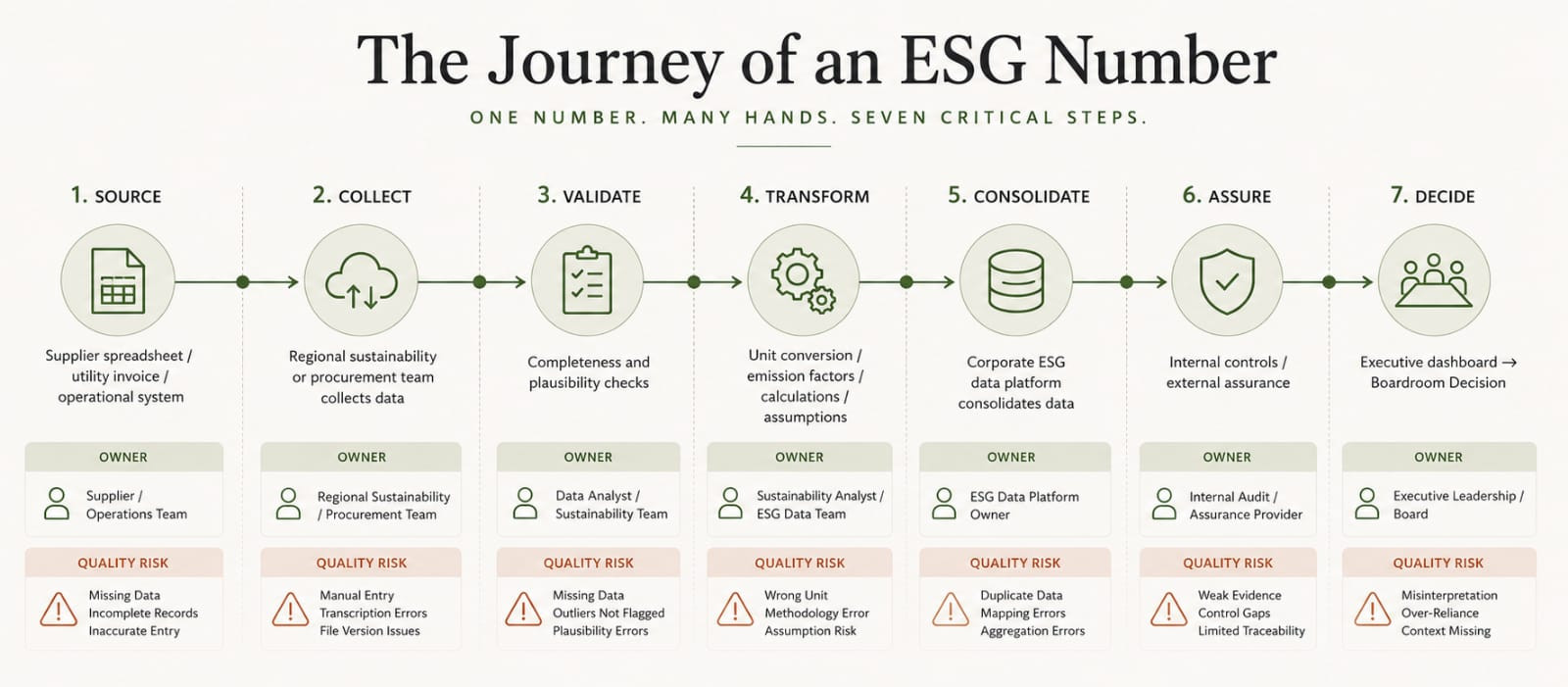
Stage One: The Supplier Spreadsheet
The ESG data supply chain often begins far away from headquarters. A supplier may be asked to report energy consumption, water use, emissions, waste, workforce information or other sustainability indicators. The supplier may have sophisticated environmental-management systems. Or it may have a spreadsheet. That distinction matters.
A spreadsheet is not inherently unreliable. The problem is what happens around it. If the supplier does not have a standardized definition for the requested metric, two suppliers can submit numbers that appear comparable but were produced using completely different methods. One supplier might report calendar-year data. Another might report financial-year data. One might include subsidiaries. Another might exclude them. One might measure actual consumption. Another might estimate it. The spreadsheet is merely the visible surface. The deeper issue is data governance.
Data Ownership Is the First Control
One of the simplest questions in ESG reporting is also one of the most important: Who owns this number? Not who entered it. Who is accountable for it. A procurement team may collect supplier information, but the supplier may own the original data. A facilities team may own electricity consumption. HR may own workforce data. Finance may own expenditure information. The sustainability team may consolidate all of it.
If ownership is unclear, accountability becomes unclear too. This creates a familiar corporate phenomenon: everyone touched the number, but nobody truly owns it. A mature ESG data architecture therefore needs clearly defined data owners, collection responsibilities, validation rules and escalation procedures. The objective is to make every important metric traceable to a responsible source.
Then the Number Gets Transformed
Raw ESG data rarely travels unchanged. Suppose a supplier reports 500,000 kWh of electricity consumption. That number may need to be converted into emissions using an appropriate emissions factor. Now the reported emissions figure depends on at least two inputs: Electricity consumption + Emission factor = Estimated emissions. Change the emission factor, and the result changes. The same thing happens across ESG reporting. Production data may be multiplied by an emissions factor. Waste volumes may be classified into treatment categories. Workforce information may be aggregated. Water data may be normalized by production. Supplier-level information may be allocated across business units.
Each transformation should therefore have a documented methodology. Otherwise, the final number can be correct mathematically while still being difficult to defend. This is why ESG data lineage is so important. The board should not only be able to see the result. The organization should be able to reconstruct how it got there.
The Hidden Chain of Controls
A reliable ESG data supply chain needs controls at multiple stages. At collection, controls should check whether data is complete and whether the reporting period is correct. At validation, organizations can check for anomalies, impossible values, sudden changes and inconsistencies. During transformation, methodologies and assumptions need to be documented. During consolidation, duplicate records and organizational-boundary issues need to be identified. Before reporting, management review and assurance procedures provide another layer of scrutiny.
The principle is similar to financial reporting. Nobody expects an important financial number to appear on a balance sheet without a trail of records, controls and reviews behind it. ESG information is increasingly moving toward the same expectation. The International Auditing and Assurance Standards Board has noted the growing demand for assurance over sustainability and ESG reporting, reflecting the increasing importance of reliable non-financial information to investors and other stakeholders.

When Data Quality Becomes a Board Problem
A reliable ESG data supply chain needs controls at multiple stages. At collection, controls should check whether data is complete and whether the reporting period is correct. At validation, organizations can check for anomalies, impossible values, sudden changes and inconsistencies. During transformation, methodologies and assumptions need to be documented. During consolidation, duplicate records and organizational-boundary issues need to be identified. Before reporting, management review and assurance procedures provide another layer of scrutiny.
The principle is similar to financial reporting. Nobody expects an important financial number to appear on a balance sheet without a trail of records, controls and reviews behind it. ESG information is increasingly moving toward the same expectation. The International Auditing and Assurance Standards Board has noted the growing demand for assurance over sustainability and ESG reporting, reflecting the increasing importance of reliable non-financial information to investors and other stakeholders.
From Spreadsheet to System
The obvious response is to replace spreadsheets with ESG software. That can help. But technology alone does not solve data governance. A sophisticated platform can still contain inaccurate information if the organization has weak definitions, unclear ownership or poor controls. The real transformation is from manual data collection to managed data architecture.
Instead of asking every supplier to “send the ESG numbers,” a company can define standardized data requirements. Instead of accepting any spreadsheet format, it can establish structured templates and validation rules. Instead of allowing calculations to happen independently in different teams, it can centralize methodologies and approved factors. Instead of losing the history behind a number, it can preserve data lineage and version information. The goal is not simply to digitize the spreadsheet. It is to make the spreadsheet less important.
ESG Standards Are Becoming Part of the Data Architecture
This shift is also visible in the evolution of reporting standards. GRI's Standards provide a structured framework for organizations to report their impacts on the economy, environment and people. The framework emphasizes consistent and credible information, and its reporting principles include accuracy, comparability, completeness, timeliness and verifiability. GRI is also developing and implementing a Sustainability Taxonomy using XBRL to support digital, machine-readable sustainability reporting. The objective is to make sustainability information more accessible and usable for stakeholders such as regulators, investors and analysts.
This is significant. The future of ESG reporting is not simply about publishing more information. It is increasingly about structuring information so that it can be consumed, compared, analysed and potentially assured by machines as well as humans. That makes the underlying data supply chain even more important. If the data is going to be machine-readable, organizations need to know what the data actually represents.
The Same Number May Have Multiple Lives
Consider one emissions figure. Inside the company, it might appear in a sustainability dashboard. In the annual report, it becomes a disclosure. For an investor, it becomes an input into a portfolio model. For a bank, it may influence climate-risk analysis. For a regulator, it becomes part of a compliance submission. For an auditor, it becomes an assurance subject. For an AI system, it becomes a data point used to generate analysis. One number. Multiple lives.
That means the organization needs confidence that the underlying value remains consistent as it travels between systems. This is where data lineage becomes powerful. A well-designed ESG data architecture can preserve the relationship between the reported value and its source, transformations, assumptions, approvals and assurance status. The number becomes traceable. And traceability is what allows information to become trustworthy at scale.
What Happens When the Data Supply Chain Breaks?
The most dangerous ESG data problems are not always dramatic. They can be tiny. A supplier changes its reporting methodology. A facility changes its meter. A spreadsheet formula is overwritten. An emission factor is updated. A reporting boundary changes. A subsidiary is accidentally counted twice. A missing value is replaced by an estimate without being clearly labelled. Each individual event may appear insignificant.
But these small errors can accumulate as data moves through the organization. By the time the final number reaches the board, the original problem may be almost impossible to identify. This is why data lineage should not be treated as a technical luxury. It is a control mechanism.
The Boardroom Is the Final Consumer, Not the Starting Point
By the time ESG information reaches the board, most of the work has already happened. The board does not collect supplier data. It does not calculate emissions factors. It does not reconcile spreadsheets. It does not validate every operational metric. It consumes the result. That makes the board the final consumer in the ESG data supply chain. And the further a number travels from its source, the easier it becomes to forget how much processing happened along the way.
A mature organization should therefore be able to answer a simple question when a director challenges a metric: “Where did this number come from?” The answer should not be: “It was in the sustainability report.” It should be: “It came from these suppliers and operational systems, was collected during this period, transformed using this methodology, validated by these controls, reviewed by these owners and assured to this level.” That is what decision-grade ESG data looks like.
What an Audit Trail for ESG Data Could Look Like
Imagine clicking on a board-level emissions metric. Instead of seeing only the number, the system reveals its lineage. Scope 3 emissions: 4.8 million tCO₂e. Then: Source data: 1,240 suppliers. Reporting period: FY2026. Data coverage: 86%. Estimated data: 14%. Calculation methodology: approved corporate methodology. Emission factors: current approved dataset. Validation status: completed. Management review: completed. External assurance: limited assurance. Last updated: August 2026.
Suddenly, the number has context. The board can see not only what the company believes its emissions are, but how confident it should be in that number. That distinction becomes increasingly important as ESG information is used for capital allocation, risk management and strategic planning.
The Next Generation of ESG Systems Will Manage Lineage, Not Just Numbers
The future ESG platform is unlikely to be just a nicer version of an Excel sheet. It will need to understand relationships. Supplier → Data point. Data point → Calculation. Calculation → Metric. Metric → Disclosure. Disclosure → Decision. Each relationship creates a chain of accountability. The system should know who owns each stage, what controls apply and what evidence supports it.
This is particularly important as companies move toward more digital sustainability reporting. GRI's digital taxonomy initiative demonstrates the direction of travel: sustainability information is increasingly being structured for machine-readable reporting rather than existing only as narrative documents. The consequence is that ESG data management will increasingly resemble enterprise data management. And that is probably overdue.
From ESG Reporting to ESG Data Operations
The deeper transformation is organizational. Once ESG data becomes critical to decisions, companies need an operating function responsible for making that data reliable. That function may sit across sustainability, finance, IT, risk and internal audit. Its responsibilities could include defining ESG data ownership, standardizing measurement methodologies, managing data collection, maintaining data lineage, monitoring quality, controlling assumptions, managing changes, supporting assurance and connecting ESG data with enterprise systems.
This is no longer just reporting. It is ESG data operations. And the companies that build this capability early may have an advantage as sustainability information becomes increasingly regulated, digitized and integrated into financial decision-making.
The ESG Data Supply Chain Needs Its Own Quality Standards
A physical supply chain has quality controls. Materials are inspected. Suppliers are assessed. Products are tracked. Defects are identified. The same logic should apply to ESG data. Every important data point should have an origin. Every transformation should be documented. Every assumption should be visible. Every owner should be identifiable. Every material risk should have a control.
And every reported number should be capable of being traced back to evidence. GRI's verifiability principle captures the underlying idea particularly well: organizations should structure their information and controls so that others can examine the quality of reported information and identify original sources and supporting evidence. That is essentially supply-chain thinking applied to information.
The Real ESG Infrastructure Is Hidden Beneath the Report
The sustainability report is what stakeholders see. The ESG data supply chain is what makes the report possible. Behind every percentage, emissions figure, target and performance indicator is a chain of people, systems, calculations, assumptions and controls. If that chain is weak, the final report can look polished while remaining fragile underneath. If the chain is strong, the organization gains something much more valuable than a compliant report. It gains decision-grade information.
That information can move from suppliers to operations, from operations to sustainability teams, from sustainability systems to finance, from finance to executives and finally into the boardroom without losing its identity along the way. The future of ESG reporting may therefore depend less on how impressive the final report looks and more on how well the organization can explain the journey behind every number. Because the most important ESG question may no longer be: “What does the report say?” It may be: “Can you prove where that number came from?”
Sources and Further Reading
Global Reporting Initiative (GRI) — GRI Standards. The global framework for reporting organizational impacts on the economy, environment and people, with emphasis on credible and comparable sustainability information.
GRI 1: Foundation 2021 — Reporting Principles. Covers accuracy, balance, clarity, comparability, completeness, sustainability context, timeliness and verifiability, including the need to identify original information sources and supporting evidence.
GRI Sustainability Taxonomy — Digitalizing the GRI Standards. Explains GRI's move toward XBRL-based, machine-readable sustainability reporting and improved access to structured ESG data.
International Auditing and Assurance Standards Board (IAASB) — Sustainability and ESG Reporting Assurance. Background on the increasing demand for assurance over sustainability and ESG information and the development of assurance approaches.
GRESB — “Building Confidence in Your Data.” Discussion of ESG data coverage, completeness, accuracy, validation and assurance.
GRI — ESG Reporting in Action. A 2026 case-study series showing how digital ESG tools are being used to manage complex sustainability data, reduce manual work and improve data quality.
Further Reading: GRI — How to Use the GRI Standards. Overview of how sustainability reporting can support accountability, transparency, risk identification and decision-making.


This is such an important perspective. The journey of ESG data really matters more than most people realize. I even used an ai image generator to visualize it.